Stand in any golf shop long enough and you'll hear the same debate. One golfer swears blades are the only irons worth swinging. Another won't touch anything but a big, forgiving cavity back. Both of them are right, for their own game. The trick is knowing which one is right for yours.
This is the cavity back vs blade irons question, and it comes down to a simple trade-off: forgiveness versus feel. Cavity backs help you when you miss the center of the face, which most of us do more often than we'd like to admit. Blades reward a pure strike with feedback and shot control that a forgiving iron can't quite match. Neither is "better." One just fits your game, your swing, and your ball-striking better than the other.
By the end of this guide you'll know exactly how these two designs are built, what forgiveness actually buys you, why blades feel the way they do, and which type belongs in your bag. No tour-pro talk, no jargon for the sake of it. Just a straight answer you can act on.

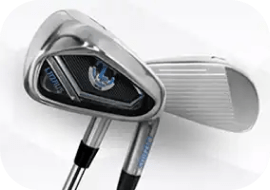
The Lazrus LAZ1 cavity-back iron set.
The names describe the shape of the iron head, specifically the back of it. Flip an iron over and look at the rear of the head and you'll see the whole story. That shape decides where the weight sits, and where the weight sits decides how the club behaves when you hit it.
A cavity back has a hollowed-out area carved into the back of the head. Instead of a solid slab of metal behind the ball, the metal is moved out to the edges, the perimeter of the head. That's why you'll hear the term "perimeter weighting."

Lazrus LAZ1 iron heads: weight pushed to the perimeter for forgiveness.
Pushing weight to the toe, heel, and sole does two things. It pulls the center of gravity lower and farther back, which helps get the ball up in the air more easily. And it makes the head far more stable when you don't strike it dead-center. Most cavity backs are cast, meaning molten metal is poured into a mold, which is an efficient way to produce a precise, consistent shape. Some higher-end cavity backs are forged for a softer feel, and we'll get to those.
Cavity backs also tend to have a slightly wider sole and a bit more offset, both of which help the everyday golfer get the ball airborne and square the face at impact. This is the design most amateurs play, and for good reason.
A blade, often called a muscle back, is the traditional shape. The back of the head is a solid, smooth mass of metal with the weight concentrated right behind the center of the face. That's the "muscle" the name refers to.
Blades are almost always forged, meaning the head is pressed and shaped from a single billet of soft carbon steel. Forging gives that famously soft, buttery sensation at impact that blade players chase. The head is compact, the topline is thin, and there's very little offset. It looks clean and precise sitting behind the ball.
But that concentrated weight is a double-edged thing. Strike the center and you get a penetrating, controllable shot with a feel nothing else matches. Miss the center and you'll know it, because there's no perimeter weighting to bail you out. Blades demand consistent ball-striking. They give a lot back to the golfer who has it.
If there's one word that decides this whole debate for most golfers, it's forgiveness. It's the single biggest practical difference between these two irons, so it's worth understanding what it really means before you spend a dime.
Forgiveness isn't magic and it isn't marketing. It's physics. When you strike the ball off-center, the clubhead wants to twist. A toe strike twists the face open, a heel strike twists it closed, and both rob the shot of ball speed. That twisting is what turns a small mistake into a big miss: lost distance and a shot that leaks offline.
A forgiving iron resists that twist. Because a cavity back's weight sits out at the edges, the head stays more stable through impact on a mishit. The technical term is a higher moment of inertia, or MOI, but you don't need the acronym. Just picture the difference between twisting a broomstick held in the middle versus one with weights taped to each end. The weighted one fights back. That's iron forgiveness in a nutshell, and it's why a slightly mishit shot with a cavity back still flies close to where you aimed.
A blade has its weight bunched in the center, so it twists more readily on an off-center hit. Great feedback, less rescue.
Here's roughly what that difference looks like on the course. The numbers below are illustrative general ranges, not a lab test of any specific club, and every golfer's exact loss depends on swing speed and how far off-center they catch it. Use it to see the pattern, not as a spec sheet.
Type of mishit |
Cavity back (approx. loss) |
Blade / muscle back (approx. loss) |
|---|---|---|
Slight toe strike |
3-7 yards short, minor push |
8-15 yards short, noticeable push |
Slight heel strike |
3-7 yards short, minor pull |
8-15 yards short, noticeable pull |
Thin / low strike |
Some roll-out, stays playable |
Flies low and long or comes up well short |
Centered strike |
Full distance, on line |
Full distance, on line, best feel |
The takeaway is simple. On your good swings, the two irons finish in a similar place. On your average and below-average swings, the cavity back keeps you closer to your target. If you don't strike the center of the face nearly every time, that gap adds up over 18 holes.
So if cavity backs are more forgiving, why does anyone still play blades? Because forgiveness isn't the only thing that matters to a good ball-striker. Feel matters too, and this is where blades have always earned their loyalty.
Feel is the information your hands get at impact. With a forged blade, that solid chunk of soft steel behind a thin face transmits a lot of feedback up the shaft. A flushed shot feels soft and almost effortless. A slight mishit feels different, and you can tell exactly where on the face you caught it.
For a skilled player, that feedback is a coaching tool. It tells them to make a small adjustment on the next swing. Blades also let the better player shape shots on command, hitting a controlled fade or draw or flighting the ball down into the wind, because the compact head and centered weight respond to what the hands do. That control is the real prize, and it's why blades never went away.
Here's what a lot of golfers don't realize: the feel gap isn't what it used to be. A cast, chunky cavity back from decades ago did feel clicky and hollow compared to a forged blade. Today's cavity backs are a different animal.
Manufacturers now forge cavity backs, use softer steels, and add internal materials that dampen vibration, so many modern game-improvement irons feel genuinely soft at impact while keeping all that perimeter-weighted forgiveness. You no longer have to choose between "feels great" and "forgives my misses" the way players once did. A well-made forged cavity back gives an everyday golfer a huge slice of that premium feel without giving up the help. That's exactly the space where a value-focused brand can deliver tour-level performance without the tour-level price tag.
Enough theory. Let's get you to an answer. For the vast majority of golfers reading this, the honest recommendation is a cavity back, and the reason is your own scorecard: the more forgiveness you have, the more of your mishits stay in play and near the target.

A forgiving cavity back keeps mishits closer to your target.
Handicap isn't a perfect guide, because it's really a stand-in for how consistently you strike the ball. But it's a useful shortcut. Here's the general rule that holds up in most fitting bays.
Handicap range |
Recommended iron type |
|---|---|
20+ (higher handicap / beginner) |
Game-improvement cavity back (max forgiveness, wider sole) |
10-20 (mid handicap) |
Cavity back, or a players-cavity for a bit more workability |
5-10 (low handicap) |
Players-cavity or a mixed set (see below) |
Under 5 (skilled, consistent striker) |
Blades or blade-style players irons, if you love the feel and control |
If you're somewhere in the 12-25 range like most weekend golfers, this isn't a close call. A cavity back will lower your scores. Save the blades for the day your ball-striking is so consistent that you're giving up more in forgiveness than you're gaining in control.
You don't actually have to pick one design for all your irons. A lot of good players build what's called a combo or mixed set: more forgiving cavity backs in the long irons, where mishits hurt most and getting the ball airborne is hardest, and more compact, workable irons in the short irons, where control matters more and you're striking the ball cleanly anyway.
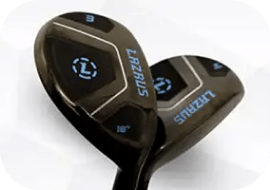
There's an even simpler version of this idea that helps mid and higher handicappers: swap your hardest-to-hit long irons for hybrids entirely. A hybrid launches easier and forgives more than a 3, 4, or even 5-iron for most golfers, which is why iron-and-hybrid sets and dedicated hybrids have become bag staples. If you've never trusted your long irons, that alone can save you shots. New to the club? Our guide on how to hit a hybrid walks you through it.

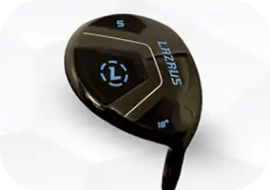
The Lazrus LAZ1 hybrid: an easy-launching swap for hard-to-hit long irons.
This is where the value angle actually matters to your wallet. Lazrus irons are cavity-back, forgiving designs built in the same kind of facilities that produce clubs selling for a lot more per club. We skip the retail markup and ship direct, so you get pro-quality, perimeter-weighted forgiveness at a fraction of the usual price. That's the whole idea: honest pricing on equipment that actually helps the everyday golfer.
You can see the full Lazrus irons collection to compare options, and there are men's and women's setups. If you're building a bag from scratch or gapping out your whole set at once, a complete Lazrus set gets you matched clubs without piecing it together one at a time. And once your ball-striking is dialed in, most of your scoring happens inside 100 yards, so it's worth knowing what a gap wedge does to get real value out of a forgiving set.

The Lazrus 13-piece set: matched clubs, one honest price.
Not really, and not for the reason people think. Two irons of the same loft will fly a similar distance when you flush them. Where the difference shows up is on mishits: a cavity back holds its distance better when you miss the center, while a blade loses more. Many game-improvement cavity backs also use stronger lofts and lower centers of gravity that can produce slightly more distance and higher launch. So if anything, a forgiving iron tends to protect your distance across a round more reliably than a blade does.
For a lot of golfers, yes. A forged cavity back gives you the soft, responsive feel that blade players love, along with the perimeter-weighted forgiveness that keeps mishits playable. You give up a little of the pure workability a true blade offers, but unless you're a highly skilled shot-shaper, you'll never miss it. For the everyday golfer who wants great feel without punishing misses, it's often the sweet spot.
Yes, and more easily than you'd expect. A flushed blade feels notably softer and gives sharper feedback about where you struck the face. A forgiving cavity back feels more uniform across the face, which is the point: it's designed to make your mishits feel and fly closer to your good shots. Hit a few of each on a launch monitor or in a fitting and you'll feel the trade-off within a handful of swings. Then let your scores, not your ego, make the call.
Ready to put more forgiveness in your bag without overpaying for it? Browse the Lazrus irons collection and get pro-quality performance at a price that respects your wallet.