







Table of Contents:
- Hybrid vs Iron: Key Differences in Design
- Hybrid vs Iron Distance: What to Expect
- When to Use a Hybrid vs Iron Based on Your Lie
- Should You Carry a Hybrid, Iron, or Both?
- Hybrid vs Iron: Frequently Asked Questions
- The Bottom Line on Hybrid vs Iron
Choosing between a hybrid vs iron is one of the most practical decisions you can make for your game. Both clubs have a place in the bag — but they perform very differently depending on your swing speed, the lie you're facing, and what kind of shot you need.
This guide breaks down the key differences in design, distance, and course conditions so you can decide exactly when to pull each club — and whether to carry one, the other, or both.
Hybrid vs Iron: Key Differences in Design
Hybrids (sometimes called rescue clubs) feature a hollow, rounded, wood-like clubhead with a low and deep center of gravity. That design makes it easier to get the ball airborne, producing a higher, softer-landing ball flight.
Irons have a thin, flat, compact head with a narrow sole and a higher center of gravity closer to the face. That means a lower, more penetrating ball flight — with better workability and wind control for golfers who can use it.
The tradeoff is consistency. Hybrids are significantly more forgiving on off-center strikes. Irons reward a precise, repeatable swing.

Hybrid vs Iron Distance: What to Expect
Hybrid Distance Ranges
Most golfers hit a hybrid between 160–220 yards. Here are typical ranges by club:
-
3-hybrid: 190–225 yards
-
4-hybrid: 180–205 yards
-
5-hybrid: 160–190 yards
-
6-hybrid: 150–170 yards
Iron Distance Ranges
Irons can match or exceed hybrid distances for golfers with a fast, consistent swing — but high-handicap players often fall short of these numbers:
-
3-iron: 180–230 yards (challenging for most amateurs)
-
4-iron: 150–170 yards
-
5-iron: 140–160 yards
Two factors affect distance most: swing speed (faster = more distance) and strike quality. Hitting the sweet spot maximizes energy transfer; fat or thin shots lose significant yardage.
When to Use a Hybrid vs Iron Based on Your Lie

From the Rough
Hybrids are the clear winner here. The rounded sole cuts through thick grass more cleanly, and the larger sweet spot reduces the penalty for imperfect contact. That's why high-handicap golfers — who spend more time in the rough — tend to carry more hybrids.
Hitting an iron from deep rough is unpredictable. Thick grass can wrap around the hosel, twist the face closed, and produce a low, spinless shot that pulls left. If the ball is sitting up, you risk a "flyer" — a shot with no spin that runs well past your target.
From a Tight or Bare Fairway Lie
Hybrid: grip down slightly, move the ball just back of center, and keep 60–70% of your weight on your front foot. Focus on a sweeping, level strike — not a scoop.
Iron: play the ball slightly back of your normal iron position to encourage ball-first contact. Hands ahead at address, weight forward (60–70% on front foot), and focus on hitting down and through — not scooping.
Off the Tee
Hybrid off the tee: tee the ball low so only a small fraction sits above the clubface. Position the ball slightly forward of center (in line with your lead ear). Keep weight centered or slightly toward the target. Use a smooth, sweeping swing.
Iron off the tee: tee the ball just above the grass. Play it exactly as you would an approach from the fairway — do not move it forward in your stance. Your normal iron swing applies; no adjustments needed.
Should You Carry a Hybrid, Iron, or Both?
Almost every golfer benefits from carrying at least one hybrid. The question is how many — and which irons, if any, to keep.
Hybrids are especially valuable for:
-
Beginners and high-handicap golfers
-
Golfers with slower swing speeds
-
Players who struggle to get 3- or 4-irons airborne
-
Seniors or anyone who has lost distance over time
-
Courses with long par 3s or thick rough
Irons remain the better choice when you need shot-shaping, wind control, or the precision that comes with a lower, more penetrating flight. Mid-to-low handicap golfers with consistent ball-striking often prefer irons from 5-iron down.
How Many Hybrids Should You Carry?
Most golfers carry 1–3 hybrids. A simple rule: find the longest iron you can hit consistently (say, a 5-iron at 150 yards), then add a hybrid that carries 10–15 yards further. You're limited to 14 clubs total, so each hybrid should fill a real distance gap.
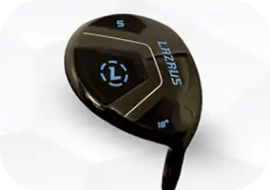
Lazrus Golf offers standalone hybrids in 2, 3, 4, and 5 options — available for both left- and right-handed players in regular, stiff, or senior flex. They also offer hybrid iron sets that replace your 4–9 irons, pitching wedge, sand wedge, and gap wedge in one package — a great option if you want to swap out your entire long iron setup.
Hybrid vs Iron: Frequently Asked Questions
Are hybrids easier to hit than fairway woods?
Yes — for most amateur golfers. Hybrids have shorter shafts (better control), a lower center of gravity (easier to launch), and a compact head that cuts through rough more cleanly. Fairway woods have a larger sweet spot and work better for players with a shallow, sweeping swing or for shots needing maximum distance from the tee or perfect fairway lies.
Can I hit a hybrid off a tight fairway lie?
Yes, and hybrids are usually a safer bet than fairway woods on tight lies. The smaller sole prevents the club from bouncing off hard turf or digging too aggressively. Focus on ball-first contact with weight forward.
What does a hybrid replace in my bag?
A 3-hybrid typically replaces a 3-iron or a 5-wood. A 4-hybrid replaces a 4-iron. A 5- or 6-hybrid can stand in for a 5- or 6-iron. The goal is to eliminate clubs you struggle to hit consistently and replace them with something you can trust.
Who should not switch to hybrids?
Low-handicap and scratch golfers who rely on shot-shaping and trajectory control often prefer irons. If you can hit a 3-iron cleanly and need to work the ball left or right, the iron gives you more control than a hybrid.
The Bottom Line on Hybrid vs Iron
The hybrid vs iron debate doesn't have a universal answer — it depends on your swing, your miss, and the shots your course demands. But for most recreational golfers, adding at least one hybrid to replace a long iron you struggle with is a straightforward performance upgrade.
Browse Lazrus Golf's hybrids, irons, and full sets to find the right mix for your game.